
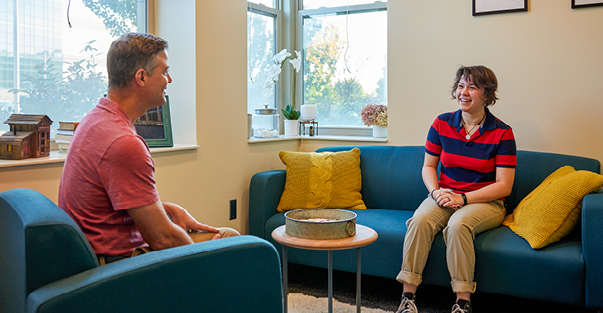
This story is one in a series about Davenport saving students time and money.
Davenport University is saving students time and money with its one-of-a-kind Bachelor of Applied Science in Applied Psychology and Master of Arts in Mental Health Counseling combined degree to provide an accelerated stackable pathway for students to become mental health counselors.
The new course pathway is 168 credits, a reduction from the typical 180-credit separate degree path. That number can be reduced substantially through transfer credits from a community college or a dual enrollment high school program. It will launch in fall 2026.
According to the Bureau of Labor Statistics, the demand for mental health counseling is projected to grow by 18% over the next decade. “This program is a high-impact, accelerated pathway designed to address the urgent mental health crisis in Michigan,” said Gerald Nyambane, Ph.D., dean of the College of Arts and Sciences and the College of Urban Education. “It will produce career-ready professionals faster and more affordably than traditional models.”
Students will have flexible course options, including in-person and online classes to attract working professionals. The program is aligned with Davenport University’s Vision 2030: “Delivering Education with Impact.”
“This new curriculum addresses the critical shortage of mental health and addiction professionals in our state and increases affordability by reducing the total credits required to reach professional practice,” said Nyambane. “By prioritizing stackable credentials, students are able to enter the workforce sooner than other pathways.”
Four elements distinguish the program from traditional psychology degrees in Michigan.
First, unlike other institutions, this is a combined-degree-only program. The bachelor’s degree serves exclusively as an intermediate credential, ensuring all enrolled students are on a track toward licensure.
Second, students will be taught a specific sequence in addiction theory, allowing them to prepare for the Certified Alcohol and Drug Counselor (CADC) exam while completing their master’s degree.
Third, the program provides students with a seamless transition from undergraduate to graduate study, removing the typical one- to two-year delay in professional entry.
And finally, the coursework is designed so students can work in entry-level technician roles such as addictions, criminal justice or education as they continue their graduate studies.
Upon completion, graduates will be equipped to:
- Apply neuroscience-based strategies for addiction recovery and learning.
- Implement evidence-informed, culturally responsive interventions for diverse populations.
- Utilize diagnostic tools to evaluate the severity of addictions and maladaptive behaviors.
- Navigate professional codes of conduct and client confidentiality in real-world clinical settings.
“This program transforms the educational model into a “driving force for positive change,” said Nyambane. “It improves access, affordability and employability for the next generation of mental health leaders.”
For more information on the Bachelor of Applied Science in Applied Psychology and Master of Arts in Mental Health Counseling combined degree, click here.
Share This Story!
This story is one in a series about Davenport saving students time and money.
Davenport University is saving students time and money with its one-of-a-kind Bachelor of Applied Science in Applied Psychology and Master of Arts in Mental Health Counseling combined degree to provide an accelerated stackable pathway for students to become mental health counselors.
The new course pathway is 168 credits, a reduction from the typical 180-credit separate degree path. That number can be reduced substantially through transfer credits from a community college or a dual enrollment high school program. It will launch in fall 2026.
According to the Bureau of Labor Statistics, the demand for mental health counseling is projected to grow by 18% over the next decade. “This program is a high-impact, accelerated pathway designed to address the urgent mental health crisis in Michigan,” said Gerald Nyambane, Ph.D., dean of the College of Arts and Sciences and the College of Urban Education. “It will produce career-ready professionals faster and more affordably than traditional models.”
Students will have flexible course options, including in-person and online classes to attract working professionals. The program is aligned with Davenport University’s Vision 2030: “Delivering Education with Impact.”
“This new curriculum addresses the critical shortage of mental health and addiction professionals in our state and increases affordability by reducing the total credits required to reach professional practice,” said Nyambane. “By prioritizing stackable credentials, students are able to enter the workforce sooner than other pathways.”
Four elements distinguish the program from traditional psychology degrees in Michigan.
First, unlike other institutions, this is a combined-degree-only program. The bachelor’s degree serves exclusively as an intermediate credential, ensuring all enrolled students are on a track toward licensure.
Second, students will be taught a specific sequence in addiction theory, allowing them to prepare for the Certified Alcohol and Drug Counselor (CADC) exam while completing their master’s degree.
Third, the program provides students with a seamless transition from undergraduate to graduate study, removing the typical one- to two-year delay in professional entry.
And finally, the coursework is designed so students can work in entry-level technician roles such as addictions, criminal justice or education as they continue their graduate studies.
Upon completion, graduates will be equipped to:
- Apply neuroscience-based strategies for addiction recovery and learning.
- Implement evidence-informed, culturally responsive interventions for diverse populations.
- Utilize diagnostic tools to evaluate the severity of addictions and maladaptive behaviors.
- Navigate professional codes of conduct and client confidentiality in real-world clinical settings.
“This program transforms the educational model into a “driving force for positive change,” said Nyambane. “It improves access, affordability and employability for the next generation of mental health leaders.”
For more information on the Bachelor of Applied Science in Applied Psychology and Master of Arts in Mental Health Counseling combined degree, click here.
Share This Story!
Stay connected!
Get the latest Davenpost News delivered to your inbox!
Related Stories
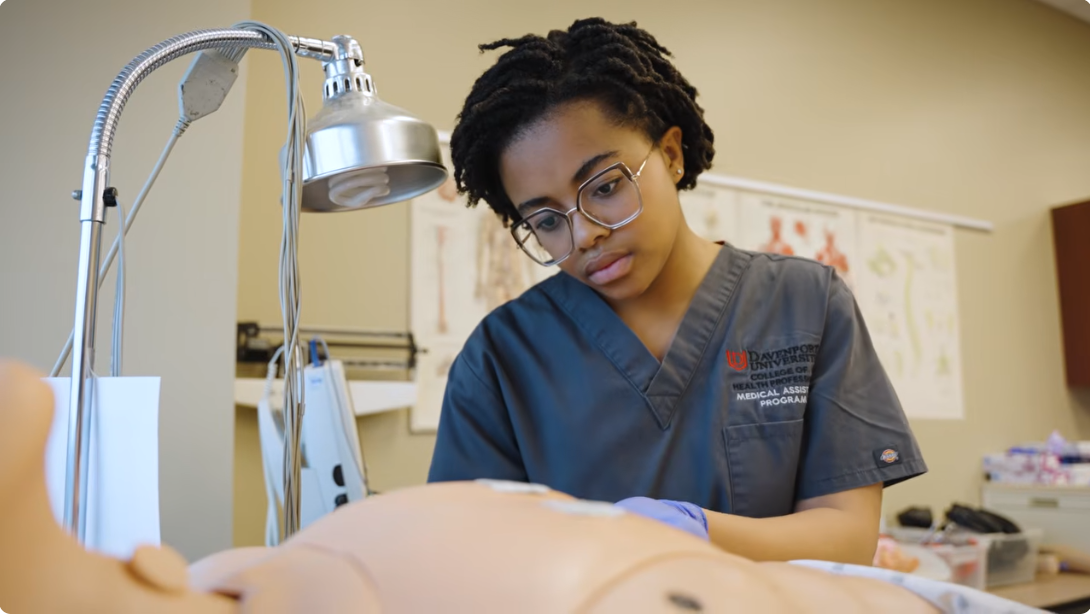
Davenport University partnered with Kent ISD students to create this video highlighting the partnership. Davenport University is addressing the healthcare [...]
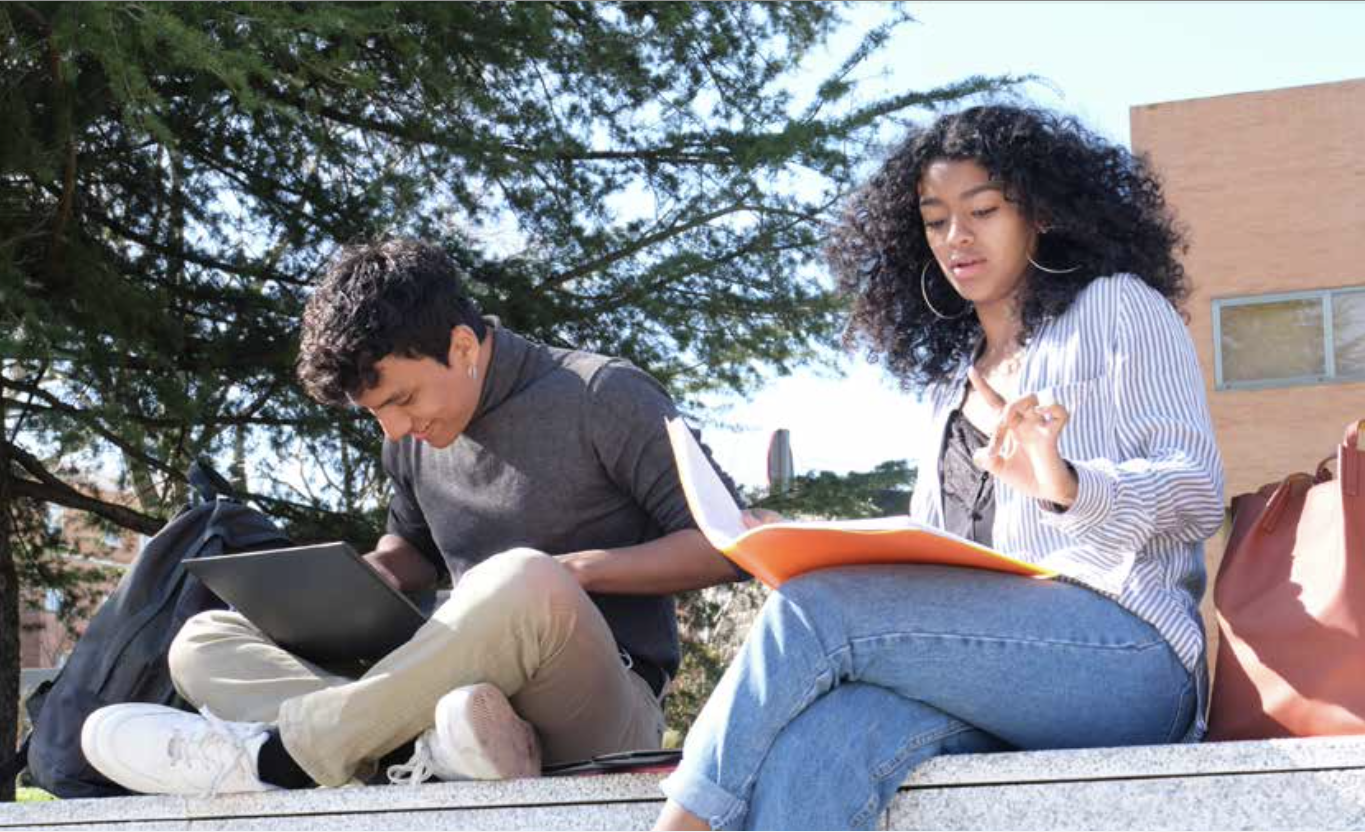
The demographics of the U.S. are shifting. According to the Pew Research Center, those of Hispanic descent make up approximately [...]

Today is National Intern Day, a time to celebrate and commemorate hardworking interns. At Davenport University, all bachelor degree programs [...]
Latest Stories
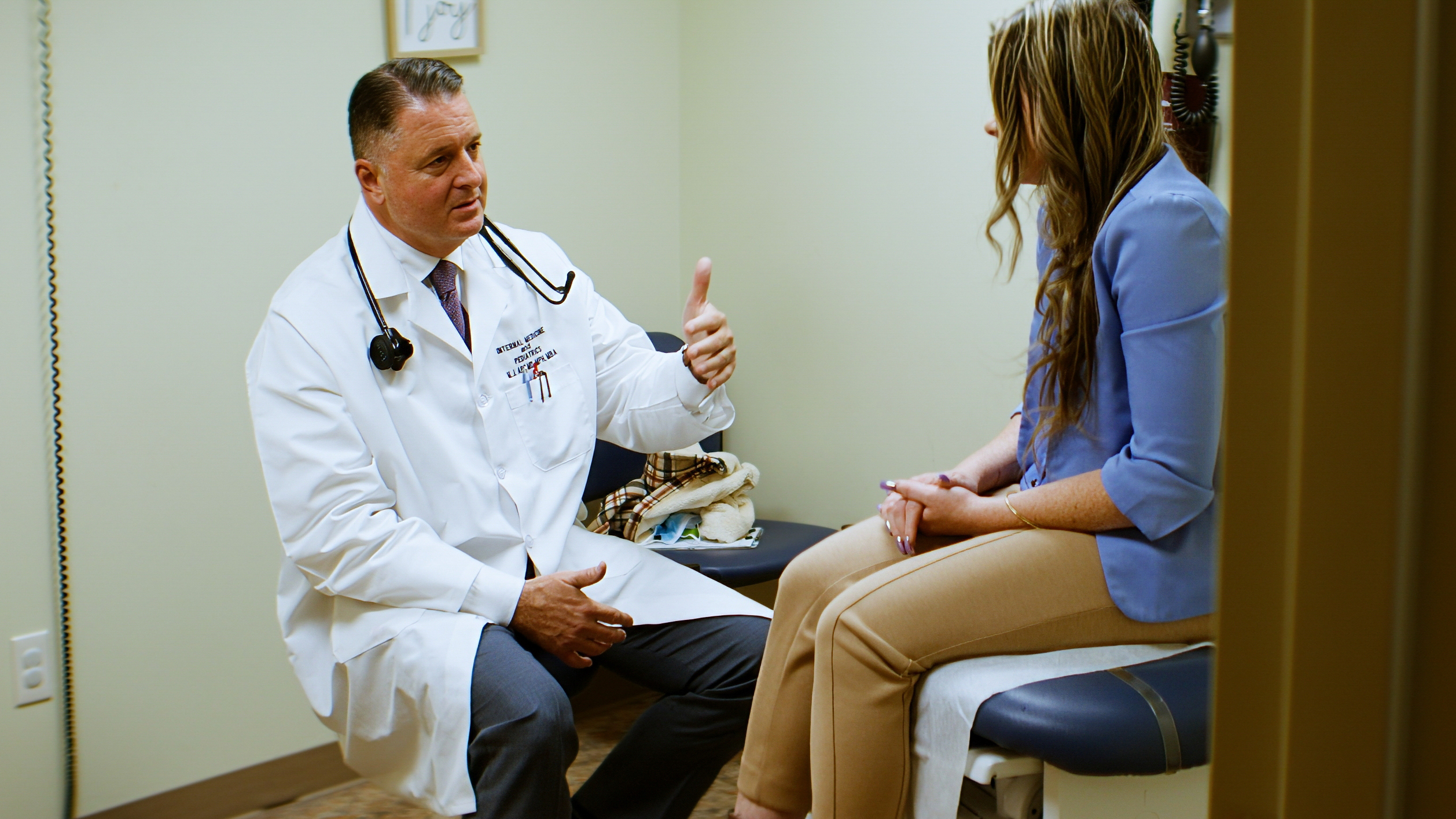
Michael App, M.D., is a lifelong resident of Grand Rapids and a busy man. He runs his own private medical [...]
Davenport University focuses on mental wellness during Mental Health Awareness Week and beyond. Mental Health Awareness Week is observed Oct. [...]
Davenport University’s Accounting, Finance and Insurance Fair on October 1 gave students and alums the chance to showcase their skills [...]