
Five-year initiative will advance Vision 2030, strengthen student success and help prepare DU graduates for Michigan’s changing workforce
Davenport University was just awarded a $3 million Strengthening Institutions Program grant through the U.S. Department of Education to prepare students for an AI-enabled workforce and strengthen systems, programs and services that support their success.
The university will use the grant to support STAR: Strengthening Through Advanced Resources. This is a university-wide initiative that directly advances Davenport’s Vision 2030 strategic plan while impacting more than 4,000 students.
STAR is designed around three areas of institutional transformation: academic programs and career readiness, student-success systems and support, and faculty and staff capacity.
“Artificial intelligence is changing nearly every profession, and Davenport has a responsibility to ensure our graduates are ready to lead now and in the future,” said Anthony W. Anderson, interim president of Davenport University. “Our Vision 2030 plan calls for AI to be integrated across our academic programs because we understand that knowing how to use AI ethically and resourcefully is essential to our students’ success. This investment allows us to accelerate the work of updating curriculum, supporting our students and providing Michigan employers with the skilled employees they need.”
The approved project is $600,000 per year for five years, beginning Oct. 1, 2026, and ending Sept. 30, 2031. Executive Vice President for Academics and Provost Gilda Gely, Ph.D., will serve as principal investigator and provide academic and institutional leadership for the five-year initiative.
“What makes this opportunity so exciting is that it reaches across the university and throughout the student experience,” Gely said. “We’ll be working directly with employers to understand the AI competencies they need, bringing those skills into our academic programs and giving students opportunities to demonstrate what they know. We’ll also be able to invest in technology, faculty and staff development and student-success tools. This grant will make immediate changes and benefit Davenport students for years to come.”
Davenport will work with employers and its Workforce Advisory Boards to identify AI skills needed within different professions. The university will expand AI-focused certificates, micro-credentials and digital badges and experiential learning opportunities, while creating new ways for students to demonstrate AI competencies.
A more connected IT system will allow the university to expand its use of data, predictive analytics and AI-enabled tools in advising, academic planning, tutoring and coaching. The goal is to use technology to enhance personal interaction, not replace it. The tools may help faculty identify earlier when a student may need additional support, freeing up more time for direct, person-to-person engagement focused on helping students succeed.
The STAR AI Faculty Fellows Program will develop faculty expertise and create opportunities for faculty members to integrate AI into teaching and learning. This will create a clear and sustainable framework for building faculty expertise and sharing effective practices across the university.
Central to this approach, responsible and ethical AI use will be embedded throughout the initiative with established university-wide guidelines that address privacy, transparency, academic integrity, fairness and human-centered decision-making.
“STAR is intended to create lasting institutional change,” said Gely. “Successful strategies we develop during the five-year grant period will become part of our operations, so the work continues after the federal funding period ends.”
Share This Story!
Stay connected!
Get the latest Davenpost News delivered to your inbox!
Related Stories
Davenport's Dean of the College of Health Professions Amy Stahley, Ph.D., understands the nursing shortage in Michigan and also has [...]
Davenport President Richard J. Pappas addresses attendees. Davenport University leaders, trustees, employees and guests gathered December 10 on [...]
Davenport University announced gifts totaling $210,000 from two foundations committed to the Midland community. The Charles J. Strosacker Foundation and [...]
Latest Stories

Five-year initiative will advance Vision 2030, strengthen student success and help prepare DU graduates for Michigan’s changing workforce Davenport [...]
Davenport University is giving its nursing students a new opportunity to launch their careers with less debt through a new [...]
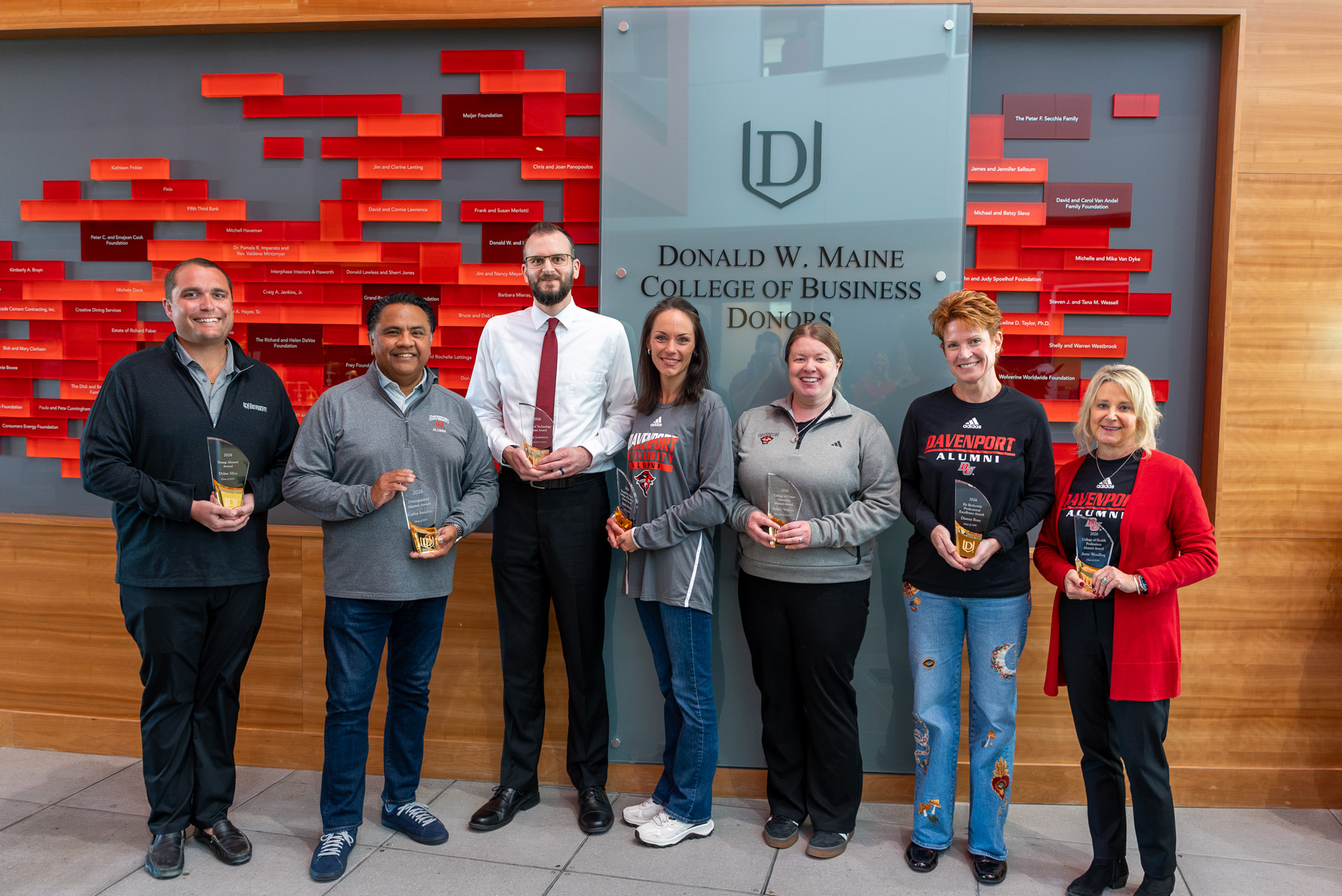
Alumni Awards Celebration recipients, from left to right: Dylan Silva, Class of 2021, Carlos Sanchez, Class of 2007, Chris Lammers, [...]