
When Sarah Hansen, Davenport University College of Health Professions faculty member, was invited to speak to her daughter’s seventh-grade class at Thornapple Kellogg Middle School, she knew she had been presented with a special opportunity. For Hansen, the visit wasn’t just about doing her daughter a favor; it was about planting seeds in the minds of students on the cusp of imagining their future careers.
“I firmly believe in educating future generations,” said Hansen. “Even at this age, we can introduce students to the wide variety of career and educational options available to them at a time when they are just beginning to think about what career they might like to pursue someday,” she said.
While it can be hard to keep the attention of a classroom full of middle school students, Hansen ensured her success by providing hands-on activities to enhance the learning environment, which led her visit to be anything but boring. She led the students through an eye-opening experiment and several engaging, hands-on activities to keep them interested and open to learning.
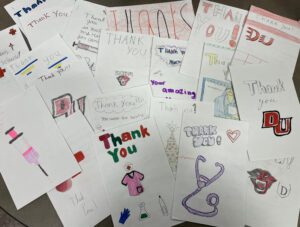 Lindsey Baxter, Thornapple Kellogg’s Careers class teacher, appreciated the time Hansen spent in her classroom. “We had a fantastic visit from Sarah,” said Baxter. “She provided an engaging and informative experience for our students, and I can’t wait to have her back.”
Hansen guided the students through a black-light hand-washing challenge designed to promote proper hand hygiene and infection prevention. During the experiment, two students were asked to wash their hands and use a black light to expose areas they may have missed.
Hansen said that the black light helped demonstrate the presence of germs and how quickly they spread by making certain substances glow under UV light. “While germs themselves are not visible under a black light, I used fluorescent lotions to mimic germs,” she said. “When these substances are exposed to a black light, they glow, revealing areas missed during handwashing. This demonstrated how contamination spreads through touch and identifies high-touch surfaces that collect germs,” she said.
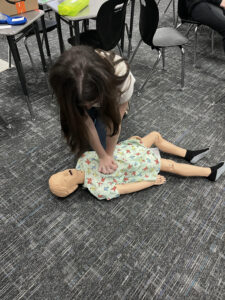 She also introduced the concept of cardiopulmonary resuscitation (CPR) to the class, something Hansen said is important for middle schoolers to know.
“Exposing middle schoolers to the basics of CPR builds early life-saving knowledge, confidence, and a sense of civic responsibility at a developmentally appropriate stage,” she said. “Teaching them this skill ensures more bystanders are prepared to act rather than hesitate during an emergency.”
“I really liked helping my mom with the CPR demonstration,” said Annabella. “I showed my class the right way to position someone when performing CPR.”
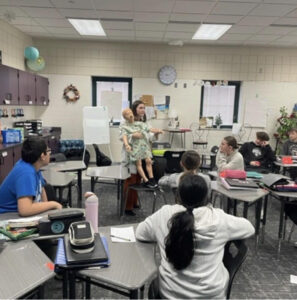
Another highlight of Hansen’s visit was when she introduced students to a pediatric simulator, which is a realistic medical training manikin designed to represent infants, children and adolescents. Pediatric simulators are typically used by nursing students for educational purposes and to practice clinical skills before applying them to real patients. But to these seventh graders, the simulator provided a glimpse into the fascinating world of nursing.
“The kids were intrigued with the pediatric simulator and all it was capable of. They were really excited to get their hands on it and test it out,” said Hansen.
“We had a nice talk about the different educational pathways available to the students, including associate, bachelor, master and doctoral degrees and career possibilities within those degree levels,” she said. “Specifically, we talked about the roles, responsibilities and educational requirements to be a registered nurse and an academic educator, and what Davenport has to offer.
The class also heard about Hansen’s career path, which began by serving children and families and later focused on educating the next generation of teachers.
Hansen first worked as a pediatric neuro-behavioral nurse at Helen DeVos Children’s Hospital for eight years, caring for children and adolescents with complex behavioral, emotional and neurodevelopmental conditions. She performed assessments, developed care plans, managed medications, and supported families dealing with autism, epilepsy, ADHD and other developmental disorders.
She then transitioned to Davenport University in 2018, where she teaches foundations of nursing and mental health nursing at the W.A. Lettinga Grand Rapids Campus.
“The best part about teaching nursing students is witnessing ‘ah ha’ moments as theory clicks into clinical practice,” said Hansen. “Watching nursing students transform from novice learners to confident, compassionate healthcare professionals is so rewarding.”
Share This Story!
When Sarah Hansen, Davenport University College of Health Professions faculty member, was invited to speak to her daughter’s seventh-grade class at Thornapple Kellogg Middle School, she knew she had been presented with a special opportunity. For Hansen, the visit wasn’t just about doing her daughter a favor; it was about planting seeds in the minds of students on the cusp of imagining their future careers.
“I firmly believe in educating future generations,” said Hansen. “Even at this age, we can introduce students to the wide variety of career and educational options available to them at a time when they are just beginning to think about what career they might like to pursue someday,” she said.
While it can be hard to keep the attention of a classroom full of middle school students, Hansen ensured her success by providing hands-on activities to enhance the learning environment, which led her visit to be anything but boring. She led the students through an eye-opening experiment and several engaging, hands-on activities to keep them interested and open to learning.
Lindsey Baxter, Thornapple Kellogg’s Careers class teacher, appreciated the time Hansen spent in her classroom. “We had a fantastic visit from Sarah,” said Baxter. “She provided an engaging and informative experience for our students, and I can’t wait to have her back.”
Hansen guided the students through a black-light hand-washing challenge designed to promote proper hand hygiene and infection prevention. During the experiment, two students were asked to wash their hands and use a black light to expose areas they may have missed.
Hansen said that the black light helped demonstrate the presence of germs and how quickly they spread by making certain substances glow under UV light. “While germs themselves are not visible under a black light, I used fluorescent lotions to mimic germs,” she said. “When these substances are exposed to a black light, they glow, revealing areas missed during handwashing. This demonstrated how contamination spreads through touch and identifies high-touch surfaces that collect germs,” she said.
She also introduced the concept of cardiopulmonary resuscitation (CPR) to the class, something Hansen said is important for middle schoolers to know.
“Exposing middle schoolers to the basics of CPR builds early life-saving knowledge, confidence, and a sense of civic responsibility at a developmentally appropriate stage,” she said. “Teaching them this skill ensures more bystanders are prepared to act rather than hesitate during an emergency.”
“I really liked helping my mom with the CPR demonstration,” said Annabella. “I showed my class the right way to position someone when performing CPR.”
Another highlight of Hansen’s visit was when she introduced students to a pediatric simulator, which is a realistic medical training manikin designed to represent infants, children and adolescents. Pediatric simulators are typically used by nursing students for educational purposes and to practice clinical skills before applying them to real patients. But to these seventh graders, the simulator provided a glimpse into the fascinating world of nursing.
“The kids were intrigued with the pediatric simulator and all it was capable of. They were really excited to get their hands on it and test it out,” said Hansen.
“We had a nice talk about the different educational pathways available to the students, including associate, bachelor, master and doctoral degrees and career possibilities within those degree levels,” she said. “Specifically, we talked about the roles, responsibilities and educational requirements to be a registered nurse and an academic educator, and what Davenport has to offer.
The class also heard about Hansen’s career path, which began by serving children and families and later focused on educating the next generation of teachers.
Hansen first worked as a pediatric neuro-behavioral nurse at Helen DeVos Children’s Hospital for eight years, caring for children and adolescents with complex behavioral, emotional and neurodevelopmental conditions. She performed assessments, developed care plans, managed medications, and supported families dealing with autism, epilepsy, ADHD and other developmental disorders.
She then transitioned to Davenport University in 2018, where she teaches foundations of nursing and mental health nursing at the W.A. Lettinga Grand Rapids Campus.
“The best part about teaching nursing students is witnessing ‘ah ha’ moments as theory clicks into clinical practice,” said Hansen. “Watching nursing students transform from novice learners to confident, compassionate healthcare professionals is so rewarding.”
Share This Story!
Stay connected!
Get the latest Davenpost News delivered to your inbox!
Related Stories

On a trip to Greece to celebrate his early retirement in 2017, Jason Collett, MBA ’01, and his wife were [...]

Are you feeling more stressed than ever? You’re not alone. College can be a lot to handle – especially during [...]

(Grand Rapids, Mich. – October 5, 2020) – In response to a growing need for mental health services among college [...]
Latest Stories
March is Women’s History Month, and in this story, we highlight an amazing woman doing amazing things at Davenport. [...]
March is Women’s History Month, and in this story, we highlight an amazing woman doing amazing things at Davenport. [...]
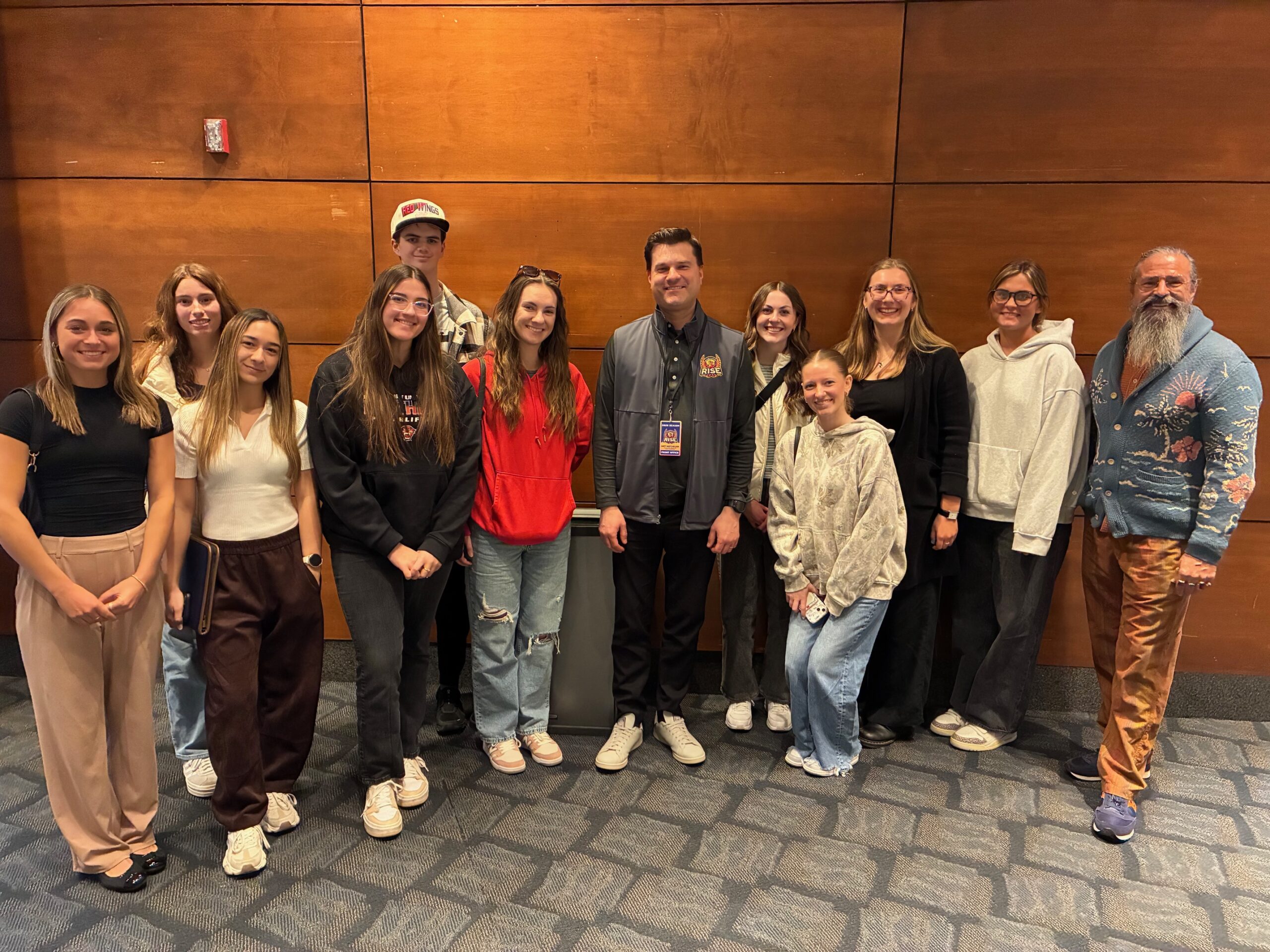
Thirteen Davenport University marketing students traded the classroom for courtside insight last week, participating in an immersive, behind-the-scenes experience [...]