

This story is one in a series about Davenport saving students time and money
“What I like most about Davenport’s program is how involved and supportive the professors are, and that they challenge us to think in different ways rather than just memorizing information,” she said. “Many of the assignments encourage creativity, critical thinking and applying concepts to real-world situations, which I think has helped me grow both professionally and personally.” – Trisha Wright
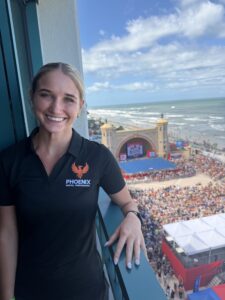 Not many college students know exactly what they want to do after graduation, and even fewer find themselves running their own business while still in school. But this is the situation Trisha Wright finds herself in, and she wouldn’t have it any other way.
By all accounts, Trisha Wright is not your average college student. The Davenport University sports management major is on track to graduate a year-and-a-half early; an accomplishment she is making possible by cashing in on articulation credits and taking 20-23 credits a semester.
But earning her bachelor’s degree in sports management is not Wright’s endgame. It is the first step to reaching her longtime goal of a career in sports psychology and mental performance coaching.
“Sports psychology is such a specialized field, and very few schools offer it as an undergraduate degree, so I chose to major in sports management,” she said. “I take as many psychology electives as I can to help build a strong foundation, and I plan to pursue a master’s degree in sports psychology and perhaps a second master’s in neuroscience.”
Wright also plans to earn her Certified Mental Performance Consultant certification and has her sights set on a possible Ph.D.
For Wright, a sports-related career was a natural fit. She began competing in archery at age 8, was nationally ranked by twelve, and she still holds a state record.
When Wright didn’t have a bow in her hand, she could be found participating in her second athletic passion: cheerleading. The sport led her to Davenport and a spot on the Panthers’ cheer and stunt team. “I was a cheerleader for fourteen years, and what many people don’t realize is the sport has a large mental aspect to it, because there is a level of trust and confidence you need to have in yourself and your teammates to perform dangerous stunts,” she said. “Davenport’s Cheer and Stunt team has a strong reputation as a mentally tough program, which closely aligns with my interests in mental performance. My experience on the team helped shape my understanding of athletics and leadership.”.
Another concept Wright understands is how sports can affect the brain, in part because it is something she needed to be cognizant of during her archery and cheerleading training. That curiosity and her sports background led her to consider a future in mental performance coaching.
An internship with Davenport’s strength and conditioning program further solidified her career choice and fueled her future by opening the door to a new and exciting opportunity.
Her main goal of the internship was to learn how to better communicate with athletes, but an assignment from her supervisor, Brock Hertrampf, strength and conditioning director, led to a snowball effect she didn’t see coming.
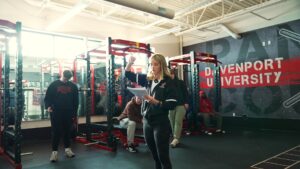 He tasked her with recommending ways to improve the men’s basketball team’s mental game, all of which were well-received by the coach and players. She continued to work with the basketball team for three weeks and was approached by Davenport’s softball coach. One thing led to another, and by the end of her internship, she was working with seven athletic teams at Davenport.
“It was an incredible opportunity because those connections not only helped me gain valuable experience but also gave me strong references that eventually turned into paying clients,” Wright said.
Her approach starts with the coaches, by teaching them how to incorporate mental strategies into their practices and their team’s culture.
“Since we started working on team culture with Trisha, our team seems much more confident and focused on team and individual goals,” said Brad Koch, Davenport softball coach. “I’ve been able to challenge my players even more in practice and competitions, and their response to those challenges has been great.”
Wright’s work with athletes to improve their mental performance focuses on things such as confidence, stress management, mindset and handling pressure during competition. “I help athletes understand what happens in the brain when they are under pressure and how they can better manage those stressors. These aren’t just tools they can use during competition; they can also be used in everyday life,” Wright said.
She is quick to point out that she is not a licensed mental health counselor, so she is very careful to stay in her lane. “I was a high-performance athlete, so I understand the pressure, discipline and mental demands that come with high-level competition,” she said. “My background, coupled with extensive research and hands-on experience working with athletes, makes me uniquely qualified to help athletes improve their mental performance.”
Wright said her sports management classes have helped her understand how the sports industry operates and where a mental performance coach fits within athletic organizations. “While at Davenport, I’ve gained knowledge in leadership, communication, operations and the business side of athletics, all of which have helped me get my business, Phoenix Mental Performance, off the ground.
“What I like most about Davenport’s program is how involved and supportive the professors are, and that they challenge us to think in different ways rather than just memorizing information,” she said. “Many of the assignments encourage creativity, critical thinking and applying concepts to real-world situations, which I think has helped me grow both professionally and personally.”
Wright also chose Davenport because she knew its smaller class sizes and student population would allow her to build deeper relationships with professors and mentors. “One of the most valuable parts of my experience at Davenport has been being connected with professors who have become mentors I can go to for advice, support and feedback on my business ideas,” she said.
Rob Spohr, a human resources faculty member, is one of the professors Wright has leaned on for advice. “Professor Spohr helped me realize that I needed to more thoroughly track my clients’ performance. While it is not a perfect system, it has allowed me to see an overall increase of 27% after five sessions with clients. This has been extremely important because it gives me measurable data to show potential clients. If athletes are going to invest in mental performance coaching, they want to see evidence that it can help improve their performance,” she said.
Another mentor, Jim Gort, a management faculty member, helped Wright develop research that she intends to use during her master’s program. “He is also helping me develop an add-on package that will help my clients discover what type of athlete they are and better understand how they perform mentally and physically,” she said.
Her long-term goal is to work with a professional or collegiate athletic team as a mental performance coach. “I would love to combine my education, athletic background and hands-on experience to help athletes perform at their highest level both mentally and physically,” she said.
While Wright sometimes finds it challenging to juggle school and running a business, she is succeeding by making necessary sacrifices and staying organized. “I strongly believe that dreams only become reality when you actively work toward them. Balancing school and a business can be difficult at times, but learning how to manage your time and stay disciplined makes anything possible.”
Share This Story!
This story is one in a series about Davenport saving students time and money
“What I like most about Davenport’s program is how involved and supportive the professors are, and that they challenge us to think in different ways rather than just memorizing information,” she said. “Many of the assignments encourage creativity, critical thinking and applying concepts to real-world situations, which I think has helped me grow both professionally and personally.” – Trisha Wright
Not many college students know exactly what they want to do after graduation, and even fewer find themselves running their own business while still in school. But this is the situation Trisha Wright finds herself in, and she wouldn’t have it any other way.
By all accounts, Trisha Wright is not your average college student. The Davenport University sports management major is on track to graduate a year-and-a-half early; an accomplishment she is making possible by cashing in on articulation credits and taking 20-23 credits a semester.
But earning her bachelor’s degree in sports management is not Wright’s endgame. It is the first step to reaching her longtime goal of a career in sports psychology and mental performance coaching.
“Sports psychology is such a specialized field, and very few schools offer it as an undergraduate degree, so I chose to major in sports management,” she said. “I take as many psychology electives as I can to help build a strong foundation, and I plan to pursue a master’s degree in sports psychology and perhaps a second master’s in neuroscience.”
Wright also plans to earn her Certified Mental Performance Consultant certification and has her sights set on a possible Ph.D.
For Wright, a sports-related career was a natural fit. She began competing in archery at age 8, was nationally ranked by twelve, and she still holds a state record.
When Wright didn’t have a bow in her hand, she could be found participating in her second athletic passion: cheerleading. The sport led her to Davenport and a spot on the Panthers’ cheer and stunt team. “I was a cheerleader for fourteen years, and what many people don’t realize is the sport has a large mental aspect to it, because there is a level of trust and confidence you need to have in yourself and your teammates to perform dangerous stunts,” she said. “Davenport’s Cheer and Stunt team has a strong reputation as a mentally tough program, which closely aligns with my interests in mental performance. My experience on the team helped shape my understanding of athletics and leadership.”.
Another concept Wright understands is how sports can affect the brain, in part because it is something she needed to be cognizant of during her archery and cheerleading training. That curiosity and her sports background led her to consider a future in mental performance coaching.
An internship with Davenport’s strength and conditioning program further solidified her career choice and fueled her future by opening the door to a new and exciting opportunity.
Her main goal of the internship was to learn how to better communicate with athletes, but an assignment from her supervisor, Brock Hertrampf, strength and conditioning director, led to a snowball effect she didn’t see coming.
He tasked her with recommending ways to improve the men’s basketball team’s mental game, all of which were well-received by the coach and players. She continued to work with the basketball team for three weeks and was approached by Davenport’s softball coach. One thing led to another, and by the end of her internship, she was working with seven athletic teams at Davenport.
“It was an incredible opportunity because those connections not only helped me gain valuable experience but also gave me strong references that eventually turned into paying clients,” Wright said.
Her approach starts with the coaches, by teaching them how to incorporate mental strategies into their practices and their team’s culture.
“Since we started working on team culture with Trisha, our team seems much more confident and focused on team and individual goals,” said Brad Koch, Davenport softball coach. “I’ve been able to challenge my players even more in practice and competitions, and their response to those challenges has been great.”
Wright’s work with athletes to improve their mental performance focuses on things such as confidence, stress management, mindset and handling pressure during competition. “I help athletes understand what happens in the brain when they are under pressure and how they can better manage those stressors. These aren’t just tools they can use during competition; they can also be used in everyday life,” Wright said.
She is quick to point out that she is not a licensed mental health counselor, so she is very careful to stay in her lane. “I was a high-performance athlete, so I understand the pressure, discipline and mental demands that come with high-level competition,” she said. “My background, coupled with extensive research and hands-on experience working with athletes, makes me uniquely qualified to help athletes improve their mental performance.”
Wright said her sports management classes have helped her understand how the sports industry operates and where a mental performance coach fits within athletic organizations. “While at Davenport, I’ve gained knowledge in leadership, communication, operations and the business side of athletics, all of which have helped me get my business, Phoenix Mental Performance, off the ground.
“What I like most about Davenport’s program is how involved and supportive the professors are, and that they challenge us to think in different ways rather than just memorizing information,” she said. “Many of the assignments encourage creativity, critical thinking and applying concepts to real-world situations, which I think has helped me grow both professionally and personally.”
Wright also chose Davenport because she knew its smaller class sizes and student population would allow her to build deeper relationships with professors and mentors. “One of the most valuable parts of my experience at Davenport has been being connected with professors who have become mentors I can go to for advice, support and feedback on my business ideas,” she said.
Rob Spohr, a human resources faculty member, is one of the professors Wright has leaned on for advice. “Professor Spohr helped me realize that I needed to more thoroughly track my clients’ performance. While it is not a perfect system, it has allowed me to see an overall increase of 27% after five sessions with clients. This has been extremely important because it gives me measurable data to show potential clients. If athletes are going to invest in mental performance coaching, they want to see evidence that it can help improve their performance,” she said.
Another mentor, Jim Gort, a management faculty member, helped Wright develop research that she intends to use during her master’s program. “He is also helping me develop an add-on package that will help my clients discover what type of athlete they are and better understand how they perform mentally and physically,” she said.
Her long-term goal is to work with a professional or collegiate athletic team as a mental performance coach. “I would love to combine my education, athletic background and hands-on experience to help athletes perform at their highest level both mentally and physically,” she said.
While Wright sometimes finds it challenging to juggle school and running a business, she is succeeding by making necessary sacrifices and staying organized. “I strongly believe that dreams only become reality when you actively work toward them. Balancing school and a business can be difficult at times, but learning how to manage your time and stay disciplined makes anything possible.”
Share This Story!
Stay connected!
Get the latest Davenpost News delivered to your inbox!
Related Stories

As seen in the Fall 2025 DU Review magazine Davenport University announced the successful completion of its historic ELEVATE [...]
When Daire O’Riordan decided to attend Davenport, his friends and family were surprised to learn he had selected a university [...]

Davenport University is participating in Tech Week Grand Rapids, September 14-19, by hosting several events at its W.A. Lettinga Grand [...]
Latest Stories

Michael App, M.D., is a lifelong resident of Grand Rapids and a busy man. He runs his own private medical [...]
Davenport University focuses on mental wellness during Mental Health Awareness Week and beyond. Mental Health Awareness Week is observed Oct. [...]

Davenport University’s Accounting, Finance and Insurance Fair on October 1 gave students and alums the chance to showcase their skills [...]